Growing up in and around the town of Charleville in North County Cork was always enjoyable, yet for me it also brought a number of challenges to overcome. I grew up with a speech impediment (a stammer or stutter), which caused more than a few difficulties throughout childhood. At times it felt as though a target followed me because of those speech difficulties. As a form of self-preservation, I often avoided larger groups altogether.
I also learned early on that silence could be a benefit. By staying quiet and observing, I noticed how people acted alone and in groups, and how differently they behaved depending on the company around them. I learned very quickly who felt safe and who did not.
From an early age, I was taught specific methods and rules to help avoid or work around the stutter, things like “don’t do this” or “don’t do that”, and for the most part, those methods worked, though nothing is ever perfect.
Back then, I formed a belief that structure and pattern were necessary tools, something required to work past the barriers in speech. Over time, that same belief worked its way into my writing.
It became a form of shield, one that shaped both my character and my development as a writer. I found it much easier to observe and describe environments, places, and landscapes than to express direct feelings or emotions. That ability is something that still serves my poetry well today.
However, just as I carefully chose and shaped words to help myself speak fluently, I began doing the same in writing, but I took it too far. I started adding more language than the meaning truly needed, to the point where I was overdressing nearly every line. While this habit served me well in managing speech, it eventually became one of the greatest hurdles in my poetry.
Early Days: Rebellion, Rules, and Finding a Pattern
I originally began writing poetry as a way of coping with my own mental health struggles. In the beginning, I wrote in a rebellious style, rejecting established forms and rules completely. I wrote only by my own laws. Looking back now, I know I was not particularly skilled at composing poetry then, even though I loved doing it.
Because of this, I worked hard to hide what I wrote, keeping it from view for as long as possible. Sadly, I lost the vast majority of those earlier poems not long after writing them. At the time, I took this loss as a sign that my style was poor and that I needed to find a way of composing that truly suited me.
I had left school before the age of sixteen to work and earn a living. However, in the 1990s I was given the opportunity to return to full-time education as an adult, and I took it with both hands. After two years of study, I entered University College Cork (UCC) to study English Literature, and by 1998 I had graduated with a BA degree.
Even throughout my studies, I still hid my love of writing poetry for many years. My inspirations were poets I deeply admired — John Donne, Thomas Kinsella, and Patrick Kavanagh. Through reading them and learning about craft, I eventually found what felt like a permanent home: the Aa Bb rhyming pattern.
This structure was familiar and comforting. It mirrored the guidelines and patterns I had learned to use for speech. I could not find comfort within Free Verse poetry because, to my mind, it seemed to have no real rules or expectations. It felt exposed and without boundaries. So I remained firmly within structured poetry, and this became the style readers would later come to recognise in my work.
One of the earliest surviving poems I wrote dates from the early 1990s and was titled All Alone. It marked the first time I moved away from complete freedom and began writing within a set form and rhyming pattern. It was eventually published in 1992 by Arrival Press in Peterborough, England, as part of an anthology of love poems.
At the time, I believed the poem was of poor quality and nowhere near the standard I wanted to achieve. Yet looking back now, I can still see an honest emotional core within it.
“Lonely walks a lonely heart, Slowly walks a lonely soul.”
At the time, I believed repetition and overstatement gave the poem strength. Looking back now, I realise those emotions were being pushed harder than they needed to be. Honest observation often carries much further than repetition ever can.
Poetry as Tribute: Structure in Grief
Life later brought immense heartache when my youngest son passed away at just five years old. I composed the poem The Butterfly as both a tribute to him and a way of trying to come to terms with that loss.
Looking back now, I can still recognise many of the same habits that appeared throughout my poetry.
“There came a day, detached from time. Sweet butterfly, your loss a painful part.”
Again, I can see overstatement and emotion being pressed harder than necessary. Even so, the structure itself became a way of containing grief, of giving shape to something that otherwise felt impossible to hold.
At the time, I knew I still had much to learn before I could feel fully comfortable and confident within poetry. The structure was helping me contain pain, but it was also preventing me from saying things simply and directly.
Lockdown, Publishing, and Realising the Habit
During the lockdown years, I finally decided to begin revealing my love for poetry publicly. Up until then, only a handful of people had ever read my work. I began publishing poems regularly on my blog, with the aim of educating myself further in different poetic styles and improving my craft to the highest standard I could reach.
Yet in studying my own work, I discovered a repeating issue that continually held me back. My chosen style remained firmly rooted in the Aa Bb rhyming scheme, often packed with alliteration, assonance, and other poetic devices. But I realised I was decorating poems far beyond what the meaning truly required.
This habit is what I now think of as “overdressed words.” I was often using archaic language or overly “poetic” phrasing intended to elevate the work, but which frequently sounded artificial or clichéd instead. Words such as “o’er,” “neath,” “oft,” or “’twas” were replacing simpler and more honest language.
At the time, I believed this was what “good poetry” sounded like. Looking back now, I realise I was often hiding true meaning and emotion behind layers of decoration, much like I once hid behind silence and observation in life.
I avoided Free Verse completely because it felt without restriction, and restriction was something I had relied upon from my earliest days learning to speak.
Mastering the Form: Folklore and Quiet Reflection
Over time, my writing within the Aa Bb style settled and matured. I became comfortable with the rhythm and the boundaries, using them to capture the things I loved most, landscape, quietness, and the heritage of where I come from.
My poem Where the Quiet Is Woven is perhaps the clearest example of this style fully formed. Here, the structure is no longer simply a rule; it becomes part of the atmosphere itself.
“Where birds gather, carefree and bright, And drink together in soft daylight, As water stirs and seems to say, The weaver knows, and shapes the day.”
Recently, I began applying this same structured style to a series of poems exploring Irish folklore and heritage, stories rooted deeply in the traditions of Charleville and passed down through generations.
These were tales of the Tuatha Dé Danann, Fairy Forts, Ring Forts, and the Banshee, stories I was taught to respect, fear, and hold close.
For the first two poems in this series, Hollow Hill and The Silver Comb, I naturally returned to structured rhyme. I felt these ancient tales deserved the order and formality that structure could provide.
The Silver Comb tells the story of the Banshee through memories shared by someone still dear to me, a family experience passed down through generations.
“For the wail is a promise, a thread, and a sign, That we are branches of a much older vine.”
This poem was warmly received, and I was proud of it. Yet even while writing it, I could still feel the boundaries I had carried since childhood shaping every line.
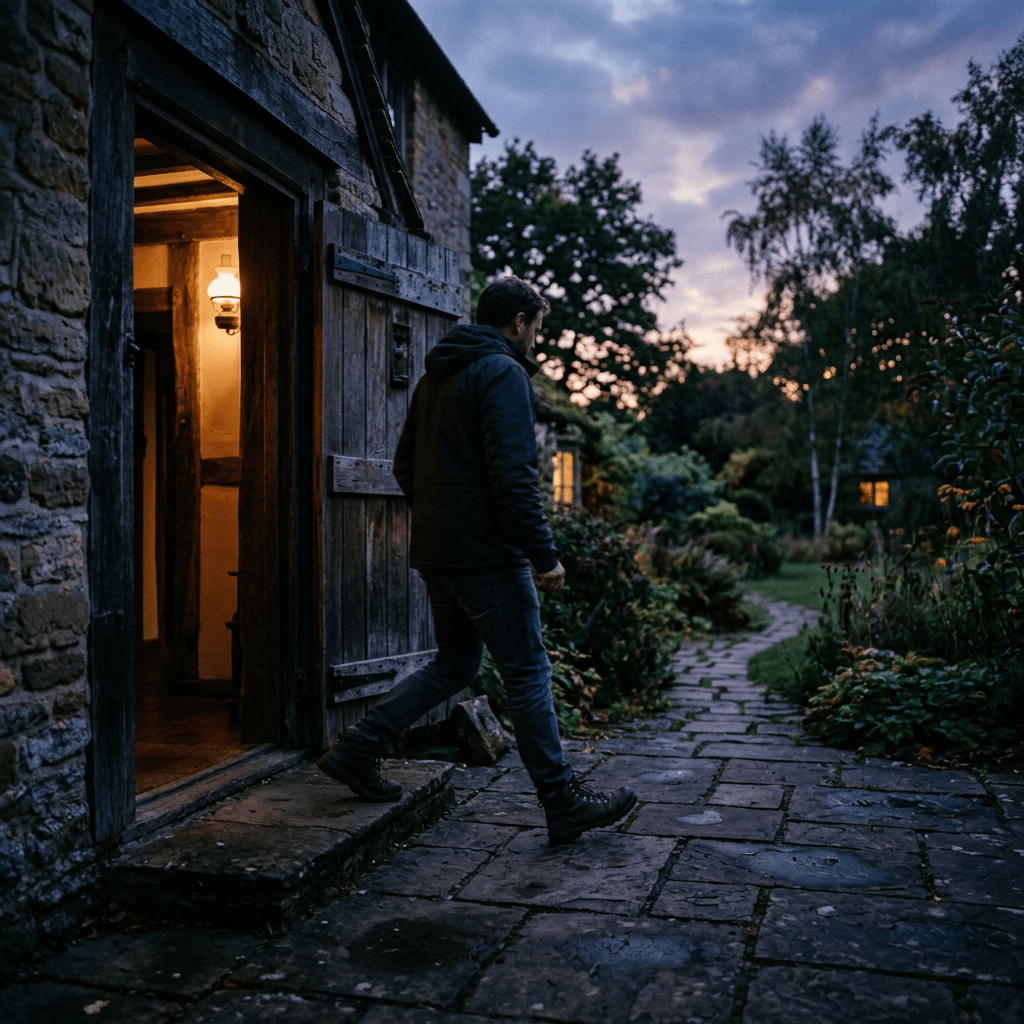
A man steps outside a warmly lit stone cottage onto a garden path at dusk
The Turning Point: Stepping Into Freedom
Everything changed with the third poem in this folklore series: Between The Lights.
As I sat down to write, I realised something fundamental, some poems dictate their own form. While many stories work beautifully within strict structure, this particular memory from my childhood wanted something different. It wanted space.
I decided to break my own rules and attempt Free Verse.
To be honest, the process was deeply uncomfortable. Writing without the familiar patterns and structures felt almost like speaking without the safeguards I had relied upon for decades. It felt alien, and several times I considered abandoning the piece altogether.
But I kept going because I realised the story itself mattered more than the safety of rhyme.
And so Between The Lights became the first poem I had ever written without strict rhyme, fixed structure, or what I now recognise as overdressed language. It tells the story of an experience from childhood, stepping briefly toward the unknown, and the respect we held for things we could never fully explain.
When preparing this poem for publication on my blog, several things struck me deeply. I realised that powerful poetry does not always come from elevated language. Sometimes the strongest line is simply the most honest one.
I also began to understand that simplicity does not weaken poetry. In many cases, straightforward words and honest description carry far greater emotional weight than polished or decorative phrasing ever could.
Between The Lights
I step from my doorway now, and the world shifts, Not forward, not back, but through some thin veil, That leads me past these old city lights, To a night back home, where the wind breathed thin.
We sat in a circle, breath misting the air, voices low, I being one who listened most, my eyes roamed wide, Words stuck fast in my throat back then, tangled like bramble, I read the dark to catch what sound might carry, To hold my tongue, and let the world speak itself.
Tales of the other world stood clear, Of those that walked between, To be honoured, not sought lightly. Still, I wondered what waited beyond the line, we feared to cross.
Then came a cry, sharp, thin, and hanging in the cold, Like a thread pulled loose from the sky. Curiosity moved our feet where words could not go, Respect walked beside us, a silent guide.
Guessing it’s source, a small one waking, where sleep hung heavy, behind panes.
As we neared, The sound slipped further on, A drifting fragile thing, that would not be caught.
Pausing... We went deeper into the darkness, Again... It shifted pulling beyond reach, Then the air felt thick and the night too wide. Warnings rising in both our bones.
No words spoken, We turned to run, Breath ragged, Hearts loud against the cold, To safer worn ground,
To let that cry, Wander where it belonged, Between the world we walk and dare not go,
Soon we spoke in lowered tones, Till laughter softened what we feared. Yet the night no longer felt the same, Though stars still burned above the dark.
I heard the tales, yet never knew their weight, Till fear took hold, and left me wide awake. Some doors are opened just a crack, then closed, And what lies past, only the dark still knows.
Most importantly, I realised that the true beauty of poetry often lies not in how ornate the language appears, but in the truth and feeling the poem carries.
I now understand far more clearly why I wrote the way I did. Those habits were not accidents; they grew from the same structures and safeguards I carried from childhood into adult life. But poetry has taught me that honest words often carry further than polished ones ever could, whether written in Free Verse or within structured rhyme.
Looking back over years of writing, I can now see growth happening gradually across many poems. Not simply in technique, but in honesty.
I hope readers continue to follow my work as I keep learning and developing as a poet. One of the most important lessons I have discovered is that the things which bind us in one part of life do not always need to follow us into every form of expression.
Just as I no longer stammer in speech, I also no longer feel the same need to hide behind over-polished language in poetry. Yet many of the lessons learned through those early struggles still remain valuable to me, both in life and in writing.
In the end, I hope at least some part of this reflection proves useful to other writers and poets. We all possess the ability to shape words into something meaningful, something capable of reaching another human being. The poets I once admired left their mark upon me through language and honesty. Perhaps, in our own small ways, we are all trying to do the same.
A Note from The Author:
Thank you for joining me on this journey of writing and discovery. Poetry, for me, is a continuous learning process. A way of finding my own voice and writing style and exploring the beauty of words.
I also write from the heart and never with the intention to cause offence. However, if anything I write ever causes discomfort, please know it is never my purpose. I am only human and occasionally typos or small errors may slip through; I do my best to correct them as soon as they are found.
Support My Work
Running this blog involves time and costs. If you enjoy my writing and would like to help keep this space alive, there are two simple ways you can support me:
Click on the advertisements, Every click helps, no matter how small and goes a long way towards covering expenses.
Buy Me A Coffee
NOTE: I am considering a different route to go rather than The Buy Me a Coffee method. I have been facing a number of issues with that site therefore I am considering another route..
If you feel inclined, you can leave a small donation via the link below. It helps with the upkeep of the site and it is always greatly appreciated.
Thank you Chuck, There was aheck of a lot of writing in this one and reediting to boost, when all was been placed in order… So much work for this piece of info….LoL
What a delightful in sight full of insightfelt reading! (sorry I am learning English and experimenting)
Thank you for sharing Pat pal🙏
Or Pen Pat pal😁
I agree with you in general, yet am diving into Old English and lost wordings not because they were more exact or different. No, some because they were ambiguous, same yet held a string of pronounciation or meaning leaning towards the next word. There is no right reading. But many possible readings held open through a word, sound or full poem create a loop of evergrowing text and writers or readers. This I once wrote in an editor letter critique fakessay: “yeah right my as(I)say(!): even me – donkey, can form more meaning than my ass could carry.” Sorry:)
Special thanks to your sharing of childhood moments. Also keep this in mind: whatever word you never said, you must have held. Felt, stuttered countless times, you better than anyone now know, what it feels, what it says and how and when it rhymes. Times.
Many times. I never learned a language in school. I kept a mothertongue as long as I would memorize possible foreign sounds and then guess their form, symbol, meaning, context and more connex, expressions, circumstances – all moving as my life in front of me. As friends that were not yet, as fear yet untold or to be hold – as silence, silent must be the listener first, to hear and understand, then try and use all words. All worded is a guessing game, from name, time, timing, impression, attempt, understood variation, failed translation, evolved widening, misheard or missed and so heard – no word is ever clear or understood, no message arrives, we just approximate by empathy and so on.
So instead of thinking to have understood and wabble in the half truths and guess within half-lies like all fluent ones do – you listened to the only truth said truly by men: silence. You practiced it by longer windows of supressed inclusion, as deeper listening and understanding. Because you did not know “how to speak” you learned to understand that every “how” holds a “how to” up to a “how not to” – by me and you. We do not know what the other thinks, much less feels, much less tried to say – so a hesitated thought is the way to truth in word and thought. Aim for the listener not for the heard or said. Mean what you meant and aim for their “understand”.
End.
My share:
I was quiet too. My mind was loud and wild. Redundant and abundantly empty to hold it. At one point I had “tics or ticks” and the doc said to inscribe me to a sport because it was due to too much energy. (Early ticks are often motoric and end in a lifelong phase often as eye-movements). My first soccer club led to a broken collar (key?) bone and I was out parentalwise. The only other club left warned me to not miss another training but I had to do the groceries at all times and so I dropped out (both parents working full time). So I kind of grew into and out of the more and more visual ticks. My horizon was impulsively tested, breached and repeatedly crossed. Think a word in a foreign language you just learned as a sound that harrasses you by asking to be named, explained and felt and feared-not anymore a million times and it becomes real. Whatever it was it now was you that was that. 30 years after seeing a scary spider in the corner of a room I know that fact whenever I look into a corner. Each thought had to be supressed, explored, torn and reborn in form, again and then dilluted into all normal other thoughts. Yet each one of them is as impulsive as the first energybursting child’s sounds when two unlearned languages as worlds in a mind would collide. Bind and unbind, wind and find – meaning of all kind.
This was just to try to bring close to you that whoever you are today is because of what hit you. Do not worry. No thing of any importance can ever be put in words. You are good.
Thank you very much. For one learning English You are doing great. Experimenting is what I love to do in poetry. this helps me when looking to creating a a poem. Creativity with imagination work fantasic together.. Have a great day my friend.
Thank you for the feedback and good advice! I think and started already stashing up old writing for the base to work with the experimental approach. Like treasure hunting for words in W. B. Yeats soon, left over letters to use as veils over bad rhyme scheme bridges:) or just lost meanings that held a time and people in rhyme, forgotten not by will but by time.
Then it is a good start. Unbelievable but I found it in the under-2€ section on a website and after one look at a love poem I immediately saw it. Compression, depth by detail, daring dreamy and dead-serious as his topics. I immediately stopped the one look, even one line read could have hooked me to lose all interest in my currently read book😁 I call that good. Words as warps into a NOW that suddenly became worth it, for and as of itself. So, banned to the shelf.:)


Bravo, Pat Bravo!!!! So love your Journey and Development!!
Chuck :-)
LikeLiked by 1 person
Thank you Chuck, There was aheck of a lot of writing in this one and reediting to boost, when all was been placed in order… So much work for this piece of info….LoL
LikeLiked by 1 person
Worth it!!!!
LikeLiked by 1 person
I do believe that it was very much worth it…
LikeLiked by 1 person
what a fantastic post mate.
LikeLiked by 1 person
Thank you Billy, I am delighted that you enjoyed it.
LikeLike
Great reading and learning a bit about your story.
LikeLiked by 1 person
Thank you.
LikeLike
What a delightful in sight full of insightfelt reading! (sorry I am learning English and experimenting)
Thank you for sharing Pat pal🙏
Or Pen Pat pal😁
I agree with you in general, yet am diving into Old English and lost wordings not because they were more exact or different. No, some because they were ambiguous, same yet held a string of pronounciation or meaning leaning towards the next word. There is no right reading. But many possible readings held open through a word, sound or full poem create a loop of evergrowing text and writers or readers. This I once wrote in an editor letter critique fakessay: “yeah right my as(I)say(!): even me – donkey, can form more meaning than my ass could carry.” Sorry:)
Special thanks to your sharing of childhood moments. Also keep this in mind: whatever word you never said, you must have held. Felt, stuttered countless times, you better than anyone now know, what it feels, what it says and how and when it rhymes. Times.
Many times. I never learned a language in school. I kept a mothertongue as long as I would memorize possible foreign sounds and then guess their form, symbol, meaning, context and more connex, expressions, circumstances – all moving as my life in front of me. As friends that were not yet, as fear yet untold or to be hold – as silence, silent must be the listener first, to hear and understand, then try and use all words. All worded is a guessing game, from name, time, timing, impression, attempt, understood variation, failed translation, evolved widening, misheard or missed and so heard – no word is ever clear or understood, no message arrives, we just approximate by empathy and so on.
So instead of thinking to have understood and wabble in the half truths and guess within half-lies like all fluent ones do – you listened to the only truth said truly by men: silence. You practiced it by longer windows of supressed inclusion, as deeper listening and understanding. Because you did not know “how to speak” you learned to understand that every “how” holds a “how to” up to a “how not to” – by me and you. We do not know what the other thinks, much less feels, much less tried to say – so a hesitated thought is the way to truth in word and thought. Aim for the listener not for the heard or said. Mean what you meant and aim for their “understand”.
End.
My share:
I was quiet too. My mind was loud and wild. Redundant and abundantly empty to hold it. At one point I had “tics or ticks” and the doc said to inscribe me to a sport because it was due to too much energy. (Early ticks are often motoric and end in a lifelong phase often as eye-movements). My first soccer club led to a broken collar (key?) bone and I was out parentalwise. The only other club left warned me to not miss another training but I had to do the groceries at all times and so I dropped out (both parents working full time). So I kind of grew into and out of the more and more visual ticks. My horizon was impulsively tested, breached and repeatedly crossed. Think a word in a foreign language you just learned as a sound that harrasses you by asking to be named, explained and felt and feared-not anymore a million times and it becomes real. Whatever it was it now was you that was that. 30 years after seeing a scary spider in the corner of a room I know that fact whenever I look into a corner. Each thought had to be supressed, explored, torn and reborn in form, again and then dilluted into all normal other thoughts. Yet each one of them is as impulsive as the first energybursting child’s sounds when two unlearned languages as worlds in a mind would collide. Bind and unbind, wind and find – meaning of all kind.
This was just to try to bring close to you that whoever you are today is because of what hit you. Do not worry. No thing of any importance can ever be put in words. You are good.
Keep up the great work.
Kindly
Your friend
LikeLike
Thank you very much. For one learning English You are doing great. Experimenting is what I love to do in poetry. this helps me when looking to creating a a poem. Creativity with imagination work fantasic together.. Have a great day my friend.
LikeLiked by 1 person
Thank you for the feedback and good advice! I think and started already stashing up old writing for the base to work with the experimental approach. Like treasure hunting for words in W. B. Yeats soon, left over letters to use as veils over bad rhyme scheme bridges:) or just lost meanings that held a time and people in rhyme, forgotten not by will but by time.
LikeLiked by 1 person
Yeats is a good addition to reading and learning from, he was one of Irelands greatest Poets..
LikeLiked by 1 person
Then it is a good start. Unbelievable but I found it in the under-2€ section on a website and after one look at a love poem I immediately saw it. Compression, depth by detail, daring dreamy and dead-serious as his topics. I immediately stopped the one look, even one line read could have hooked me to lose all interest in my currently read book😁 I call that good. Words as warps into a NOW that suddenly became worth it, for and as of itself. So, banned to the shelf.:)
LikeLiked by 1 person
good to hear..
LikeLiked by 1 person